
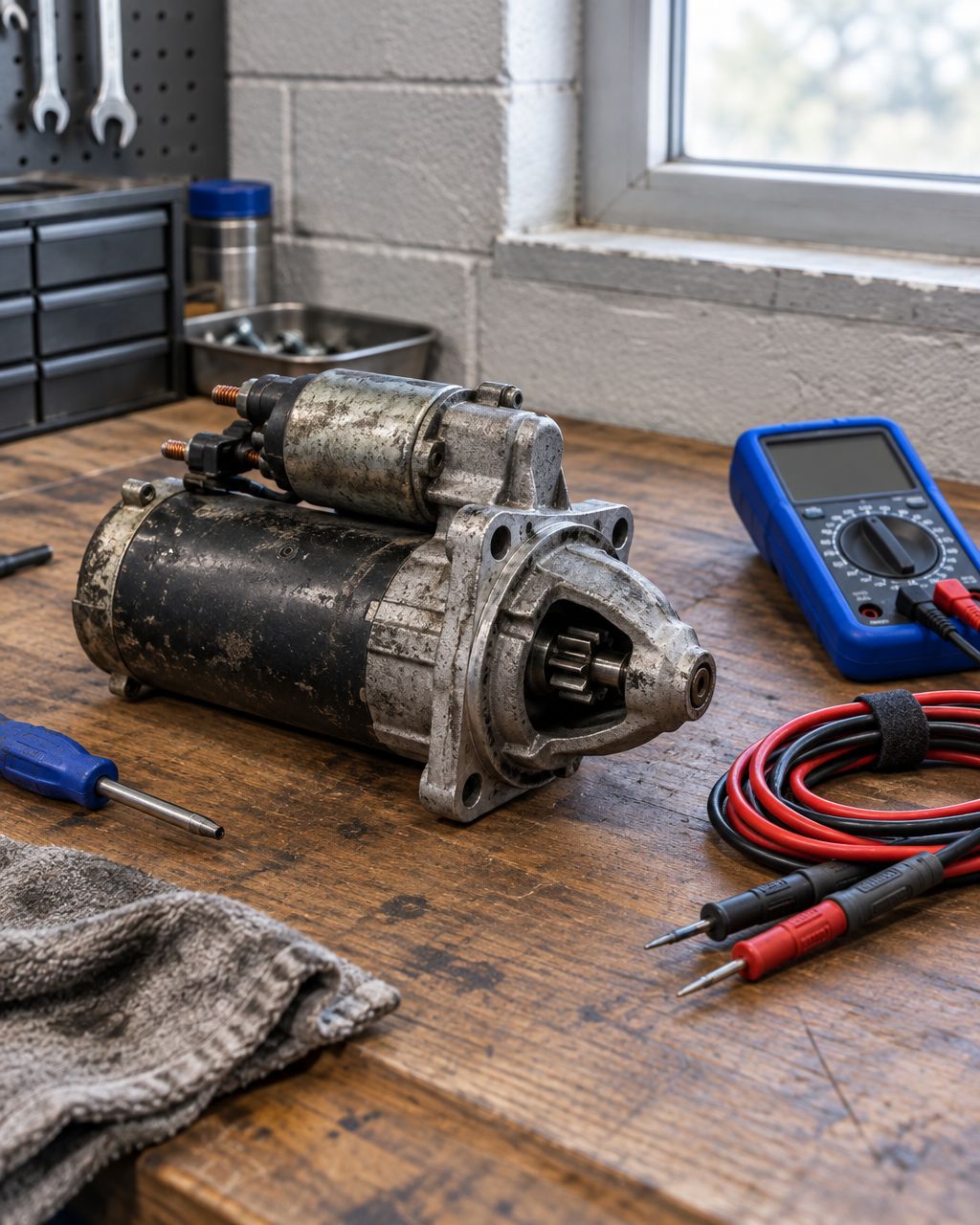
Before booking starter repair, ask whether the shop tests the battery, cables and starter circuit before recommending a replacement. Describe what happens when you try to start the vehicle, give its year, make and model, and confirm how diagnostic work and repairs are approved.
- Searching for starter repair near me should lead to diagnosis, not an automatic parts replacement.
- eForce Automotive provides appointment-based starter and electrical diagnosis in Englewood.
- Tell the shop whether the engine turns, clicks, grinds or stays silent.
- Confirm diagnostic authorization, repair approval and vehicle transport before your appointment.
What should you ask before booking starter repair in Englewood?
Ask these questions before arranging a visit:
- Will you test the starting system before recommending a starter?
- What vehicle details and symptom history should I send?
- What diagnostic work am I authorizing?
- Will you contact me before additional testing or repairs?
- Where should the vehicle be delivered if it will not start?
The purpose is to agree on a process, not diagnose the vehicle over the phone. A shop can explain what happens next without claiming to know the failed part from a clicking sound alone.
For local service details, see the auto electrical repair page. eForce Automotive is a fit for Englewood drivers seeking appointment-based starter diagnosis before authorizing repair.
Why diagnosis matters before a starter replacement
A starter motor turns the engine during starting, but it depends on the rest of the starting system. The battery must deliver enough power, the cables and connections must carry it, and the vehicle must allow the start request.
A problem anywhere along that path can leave you with a no-start complaint. Replacing the starter without checking the surrounding circuit can leave the original fault untouched.
This is why a useful booking conversation starts with symptoms rather than a requested part. You can suspect the starter and still authorize testing to confirm it. That protects you from treating an online symptom list as a repair decision.
The same principle applies to warning codes. A code is a starting point, not the name of a part. It identifies something the vehicle detected; further checks establish the cause and the appropriate repair.
Describe what happens instead of saying only “it will not start”
Two drivers can use the same phrase for different problems. One vehicle is silent when the key turns. Another turns the engine normally but never runs.
Use the closest description below when you contact the shop. These are observations to report, not diagnoses.
| What you notice | What to tell the shop | What the observation does not prove |
|---|---|---|
| Nothing happens | Whether the dashboard lights come on and whether you hear any sound | That the starter itself has failed |
| Repeated clicking | Whether lights dim and whether a jump-start changed the symptom | That the battery is the only problem |
| One distinct click | Whether the engine moves at all and whether the fault repeats | That a replacement starter is automatically required |
| Slow engine turning | Whether it happens cold, hot or under both conditions | That battery voltage alone will identify the cause |
| Normal engine turning without starting | That the engine cranks but does not run | That this is primarily a starter-motor problem |
| Grinding or unusual mechanical noise | When the noise occurs and whether it continues after releasing the start control | Which mechanical component is responsible |
Do not repeatedly operate the starter just to produce a recording. If there is smoke, a burning smell or an unusual grinding noise, stop trying to start the vehicle and seek guidance about safe transport.
Send the vehicle details before the appointment
Start with the year, make and model. Include the engine information if you know it, but do not guess. The shop can ask for the vehicle identification number, or VIN, when needed to identify the correct vehicle configuration.
Then explain the history in a short sequence:
- What happened the first time the vehicle failed to start?
- Is the fault constant or intermittent?
- Does it happen after sitting, after driving or under both conditions?
- Has the battery, starter or another electrical part already been replaced?
- Did the problem begin after another repair or accessory installation?
- Did a jump-start change anything?
A clear history helps the technician decide which conditions need to be reproduced. It does not replace testing, and a successful start at the appointment does not automatically mean the complaint is resolved.
If someone has already inspected the vehicle, bring the findings rather than only the recommended part name. A recorded test result gives the next technician more information than “another shop said starter.”
Ask what the starting-system diagnosis covers
A reasonable diagnostic plan follows the evidence. It should distinguish a weak power supply, excessive electrical resistance, a missing start command and a starter fault instead of assuming they are the same problem.
Battery condition and available starting power
A battery can illuminate the dashboard without being able to supply the power needed to turn the engine. Ask whether battery condition and charge will be checked, rather than relying only on whether the lights work.
A discharged battery also raises another question: why did it lose charge? That question can require separate investigation if charging trouble or a parked electrical drain is involved. The shop should explain additional work before extending the diagnosis.
Cables, terminals and ground connections
The starter needs a complete electrical path. A loose connection, corrosion or damage can restrict that path even when the starter motor is functional.
A voltage-drop test measures voltage lost along a circuit while it is carrying current. In plain terms, it checks whether electrical connections are preventing power from reaching the component properly. The readings need to be interpreted against the vehicle and test conditions, not one universal internet threshold.
Starter operation and the control circuit
The technician also needs to establish whether the starter receives the appropriate power and start request. Depending on the vehicle, that can involve the relay, solenoid, wiring, switches or electronic controls.
You do not need to request each individual test. Ask the shop to explain which part of the starting process is failing and what evidence supports the proposed repair.
Charging or related electrical checks when indicated
An alternator charges the battery while the engine runs. If the complaint includes repeated battery discharge or charging warnings, starting-system diagnosis can point toward a related charging concern.
That does not make every starter complaint an alternator problem. The symptoms and test results determine whether more investigation is justified.
Agree on authorization before work begins
Diagnostic authorization and repair approval are different decisions. The first permits the shop to investigate an agreed concern. The second permits the proposed repair after the findings are explained.
Before leaving the vehicle, confirm:
- What work is included in the initial diagnostic authorization.
- How the shop will contact you with findings.
- Whether further troubleshooting needs your approval.
- How you will receive and approve the repair estimate.
- What happens if the fault cannot be reproduced.
At eForce Automotive, the process is diagnosis first, an explanation of the findings, and customer approval before repair work. Additional electrical troubleshooting is discussed before proceeding.
Do not assume that approving a diagnostic visit means approving a starter replacement. If that distinction is unclear, settle it before testing starts.
What affects the diagnostic process?
The same symptom can require different work on different vehicles. These factors change what the technician needs to check:
- Whether the failure is present. A constant no-crank fault can be observed directly; an intermittent one requires attention to the conditions that trigger it.
- Previous repairs. A new battery or starter does not rule out wiring, connection or control faults.
- Vehicle configuration. Starting controls and component access differ by vehicle.
- Battery condition. A low or damaged battery can complicate interpretation of other tests.
- Related symptoms. Charging warnings, accessory faults or a security warning can change the diagnostic direction.
- Recent changes. Repairs, accessory installation or water exposure are relevant history, not automatic proof of cause.
These differences are why a repair-time promise made before inspection is not a substitute for a diagnostic plan. Ask what the next decision will be and when the shop will update you, rather than treating a generic turnaround claim as a guarantee.
Should you request repair or replacement?
Ask for a diagnosis and a proposed remedy first. Depending on the findings, the appropriate work could involve the starter, a connection or another part of the starting system.
If starter replacement is recommended, ask what confirmed the failure and whether any related fault also needs attention. A clear explanation should connect the observed symptom, the test result and the proposed work.
Avoid buying a starter simply because a symptom chart names it. Before supplying any part yourself, ask the shop how that affects its repair process and applicable terms. Do not assume a shop accepts customer-supplied parts or provides a particular warranty.
Arrange the visit before arranging transport
Starter and electrical service at eForce Automotive is appointment-based and performed in the shop at 1713 W Baltic Pl, Englewood, CO 80110. The shop does not provide mobile service.
If the car will not start, contact the shop before sending it. Confirm the appointment, arrival arrangements and the symptom being investigated, then arrange suitable transport.
Tell the transport provider about vehicle-specific restrictions, such as a car that cannot shift out of park. Follow the vehicle manufacturer's transport instructions rather than assuming every vehicle can be moved the same way.
A running vehicle also needs judgment. An intermittent starting problem can leave you stranded after your next stop; unusual noises or electrical warning signs call for guidance rather than another attempt to reproduce the fault.
FAQ
What should I ask a starter repair shop before booking?
Ask whether the shop tests the battery, cables and starter circuit before recommending replacement. Confirm diagnostic authorization, repair approval and arrival arrangements.
Does a single click mean my starter is bad?
A single click does not confirm a failed starter. Battery condition, cable connections and the starter circuit need to be evaluated before choosing a repair.
Can the dashboard lights work with a battery too weak to start the engine?
Yes. Operating dashboard lights does not prove that the battery can supply enough power to turn the engine. Battery testing checks more than whether the lights illuminate.
Should I replace the starter if the engine cranks normally but will not run?
Normal cranking means the starter is turning the engine. The reason the engine does not run needs diagnosis rather than an automatic starter replacement.
What if the car starts normally when I arrive?
Report the original conditions and any previous work even if the vehicle starts at the appointment. An intermittent fault is not proven repaired simply because it is absent during one attempt.
Can you diagnose starter trouble at my home?
eForce Automotive performs electrical work in its Englewood shop, not through mobile service. Arrange an appointment and confirm transport if your vehicle will not start.
Will repairs begin without my approval?
Repair work requires your approval. Confirm the scope of diagnostic authorization separately, and ask to be contacted before additional testing or repair work.
One last thing: bring evidence, not a parts list
A brief description of the first failure, the conditions that repeat it and the repairs already attempted is more useful than a list of possible replacement parts. Keep invoices and test results together so the technician can separate what is known from what still needs checking.
The goal of starter diagnosis is not to confirm an online guess. It is to identify the fault and explain the next step before you approve the work.